

Seasonal Allergies in Dogs: Why Your Dog Suffers Every Spring — and What Veterinarians Now Recommend
Every year, it starts again. The trees begin to bloom, the grass grows tall — and your dog begins to scratch. Bite at their paws. Rub their face against the carpet. Shake their head. You watch them suffer, and you feel helpless.

If this cycle sounds familiar, your dog is very likely dealing with seasonal allergies.
And you are far from alone. Seasonal allergies in dogs typically begin in early spring (March–April), peak through summer, and can persist well into autumn depending on your region's pollen calendar. Some dogs suffer for three to four months; others for six months or more, year after year.
But here's what most dog owners don't realize: the scratching you see on the surface is just the tip of the iceberg. What's actually happening inside your dog's body is far more complex — and far more important to understand if you want to break the cycle.
How Do You Know If Your Dog Has Seasonal Allergies?

The signs are easy to spot once you know what to look for. Dogs with seasonal allergies commonly show one or more of the following:
- Intense scratching, especially around the ears, belly, armpits, and groin
- Excessive paw licking or chewing — sometimes until the paws are red and raw
- Red, irritated skin, particularly on areas with thinner fur
- Recurrent ear infections or a persistent head shake
- Watery, red eyes
- Rubbing their face against furniture, carpets, or the ground
- Hot spots — sudden, wet, inflamed patches that seem to appear overnight
- Coat changes: dullness, dandruff, or thinning
The seasonal pattern is the key clue. If your dog's scratching, redness, and discomfort consistently worsen in spring and summer and improve in winter — that is the hallmark of seasonal allergies, not food sensitivities.
The symptoms often worsen after walks, especially on warm, windy days when pollen counts are high. Many owners notice their dog is fine indoors but starts scratching within minutes of coming home from a walk.
What Actually Causes Seasonal Allergies in Dogs?
To understand why your dog suffers so much, you need to understand what happens inside their body when pollen season arrives.

When airborne allergens — tree pollen, grass pollen, weed pollen, mold spores — land on your dog's skin or are inhaled, the immune system of a sensitive dog overreacts. It identifies these harmless particles as dangerous invaders and launches a full immune response.
Here's the chain reaction:
1. The immune system becomes unbalanced. In allergic dogs, the immune response is heavily skewed toward what scientists call a "Th2-dominant" response. This means the body produces excessive amounts of IgE antibodies against allergens, rather than maintaining a balanced immune profile.
2. Mast cells release histamine and inflammatory compounds. Once IgE antibodies bind to allergens, they trigger mast cells in the skin to degranulate — releasing histamine, prostaglandins, and inflammatory cytokines like TNF-α and IL-6. This is what causes the redness, swelling, and unbearable itch.
3. The skin barrier breaks down. Chronic inflammation damages the skin's protective lipid layer, the "brick and mortar" structure of the stratum corneum. This allows more allergens to penetrate deeper, triggering even more immune reactions. It's a vicious cycle.
4. The gut-skin axis is compromised. This is the piece most dog owners — and even some vets — miss entirely. Approximately 70% of your dog's immune system resides in the gut. Research has shown that dogs with atopic dermatitis consistently have reduced gut microbial diversity and specific patterns of gut dysbiosis. When the gut microbiome is unbalanced, the immune system loses its ability to regulate itself properly — and allergic responses become amplified throughout the body.
In other words: the root cause of seasonal allergies is not on your dog's skin. It's in their gut, their immune system, and their skin barrier — all three systems working against each other instead of together.
What Happens If You Don't Address Seasonal Allergies Properly?
Many dog owners hope their dog will simply "grow out of it" or that the scratching isn't a big deal. Unfortunately, the science tells a very different story.
The Hidden Cost of Untreated Seasonal Allergies
Left unaddressed, seasonal allergies don't just stay the same — they progressively worsen over time.
- Chronic inflammation spreads throughout the body, leading to secondary bacterial and yeast infections on the skin, between the toes, and in the ears
- The skin barrier deteriorates further each season, making your dog more reactive to allergens every year — not less
- Persistent gut dysbiosis weakens the immune system, leaving your dog vulnerable to infections, slow wound healing, and poor nutrient absorption
- Constant itching and discomfort take a psychological toll — studies show chronically itchy dogs experience anxiety, disrupted sleep, and behavioral changes including increased irritability and reduced trainability
- Repeated rounds of steroids and medications can carry their own side effects, including weight gain, increased thirst and urination, liver stress, and suppressed immune function
Each allergy season that passes without addressing the underlying causes makes the next season harder. The immune system becomes more sensitized, the skin barrier grows weaker, and the gut microbiome falls further out of balance.

How to Actually Help Your Dog With Seasonal Allergies
The conventional approach — antihistamines, steroids, or immunosuppressants — focuses on suppressing symptoms. These treatments have their place, especially during acute flare-ups. But they don't address the root causes: the gut dysbiosis, the weakened immune regulation, and the damaged skin barrier that make your dog allergic in the first place.
Veterinary research is now pointing to a fundamentally different approach: support the gut, rebalance the immune system, strengthen the skin barrier, and reduce itch signals — all at the same time.
This is exactly where Pawital's targeted product range comes in. Depending on how severely your dog is affected, there are different levels of support available.
For Dogs With Moderate to Severe Seasonal Allergies: gutQR Anti-Itch

If your dog's seasonal allergies are a real, recurring problem — causing persistent scratching, skin damage, paw chewing, or secondary infections — gutQR Anti-Itch is the most comprehensive solution available.
This is not just another probiotic. gutQR Anti-Itch is the first supplement that works on all four root causes simultaneously: gut health (with a full pre-, pro-, and postbiotic programme including colostrum), immune rebalancing, skin barrier restoration (with omega fatty acids, zinc, biotin, and evening-primrose oil), and — crucially — mast cell stabilization through PEA (Palmitoylethanolamide).
PEA is a naturally occurring compound that your dog's own body produces to fight inflammation. But dogs with chronic itching don't produce enough of it. Supplementing with ultra-micronized PEA directly targets the mast cells responsible for histamine release, achieving up to 54% inhibition of histamine release and blocking itch signals at the source.
Clinical Evidence: PEA in Dogs With Atopic Dermatitis
A landmark multicenter trial involving 160 dogs across 39 veterinary clinics tested ultra-micronized PEA at 10 mg/kg daily for 56 days. The results:
- Pruritus scores dropped from 5.7 to 3.6 on visual analog scales (p<0.0001)
- 58% of dogs experienced meaningful itch reduction
- 30% of dogs achieved near-complete relief within just 1–2 weeks
- 45% of treated dogs reached quality-of-life scores comparable to healthy animals
- Only 2.5% experienced mild, reversible side effects
Noli C. et al. (2015). Efficacy of ultra-micronized palmitoylethanolamide in canine atopic dermatitis. Veterinary Dermatology. https://doi.org/10.1111/vde.12262
This is what makes gutQR Anti-Itch unique: it delivers fast symptomatic relief through PEA, MSM and boswellia while simultaneously correcting the underlying gut, immune, and skin-barrier dysfunction that caused the problem in the first place.
For Targeted Itch Signal Support: skinQR PEA

Some dogs benefit from a focused approach to itch control, especially when used alongside a gut health protocol. skinQR PEA delivers a concentrated dose of PEA specifically designed to stabilize mast cells and reduce itch signaling.
PEA works through the endocannabinoid system, activating PPAR-α receptors on inflamed skin cells and inhibiting the cascade that leads to histamine release, redness, and scratching. Because it works through the body's own natural pathways, it can be safely combined with other supplements and medications.
This is an ideal option if your dog is already on a gut health supplement and needs additional itch support, or if you want a targeted solution alongside veterinary treatment.
For Dogs With Manageable Seasonal Allergies: Belly Biotics

Not every dog needs the full-scale intervention. If your dog has mild seasonal allergies — occasional scratching, slight redness, a slightly dull coat during pollen season — then building a strong gut and immune foundation may be all they need.
Belly Biotics is a daily probiotic treat that delivers living probiotics alongside prebiotics
(FOS, inulin, MOS, beta-glucans) and postbiotics in a format your dog will love. It supports the gut-skin axis by promoting beneficial bacterial diversity, strengthening the intestinal barrier, and modulating immune responses — the same mechanisms that clinical research has shown can reduce allergy symptoms at their source.
For dogs with manageable problems, this daily gut and immune support can make the difference between a comfortable allergy season and a miserable one.
For Immediate Topical Relief During Walks: Anti-Itch Spray
During pollen season, allergens accumulate on your dog's skin with every walk. This is a major, often overlooked trigger for seasonal flare-ups.

Anti-Itch Spray by Pawital is a 100% natural, probiotic-enzyme spray that works directly on the skin's surface. Its bacterial complex with amylase and protease degrades the allergen proteins sitting on your dog's skin — pollen, grass proteins, dander — removing the very substances that trigger the itch response. The hydrolyzed protein base adds moisture, and the water base provides immediate evaporative cooling for fast relief.
This is especially powerful for seasonal allergies specifically because the primary itch trigger is external — allergens on the skin surface. A quick spray after every walk during high-pollen days can significantly reduce your dog's scratching.
For Sensitive Dogs Who Need Gentle Bathing: Hypoallergenic Shampoo
Many dogs with seasonal allergies also have sensitive, reactive skin that can't tolerate standard shampoos. Harsh surfactants, strong fragrances, and stripping formulas make the problem worse.

Pawital Hypoallergenic Shampoo is formulated specifically for these dogs. With D-panthenol (pro-vitamin B5) and aloe vera, it gently lifts allergens during a 5-minute contact wash while actively rebuilding the skin's lipid barrier instead of stripping it. The pH is matched to canine skin (~6.5), and the ultra-mild surfactant system cleans effectively without irritation.
Used as a regular post-allergen-exposure rinse — for example, after a long walk on a high-pollen day — it removes the allergens that drive seasonal reactions while keeping the skin hydrated, calm, and resilient.
The Smart Approach: Build From the Inside, Protect From the Outside
The most effective strategy for seasonal allergies combines internal support (gut health, immune balance, skin barrier nutrition) with external protection (allergen removal, gentle skin care).
A Complete Seasonal Allergy Strategy Looks Like This:
- Rebuild the gut and immune foundation with gutQR Anti-Itch (for moderate-severe cases) or Belly Biotics (for mild cases) — ideally started 6–8 weeks before pollen season begins
- Stabilize itch signals with PEA, either through gutQR Anti-Itch or the standalone skinQR PEA
- Remove allergens from the skin after every outdoor walk using Anti-Itch Spray
- Bathe gently once or twice a week with Hypoallergenic Shampoo to lift accumulated allergens without damaging the skin barrier
- Be consistent — research shows gut health interventions need 8–16 weeks for full immune remodeling, with some studies showing benefits that persist years after supplementation
This isn't about masking symptoms with another round of steroids. It's about giving your dog's body the tools it needs to handle allergy season the way nature intended — with a balanced immune system, a strong gut, a resilient skin barrier, and properly regulated itch signals.
Your dog doesn't have to dread spring. And neither do you.
-
Belly Biotics (360 priboljškov)
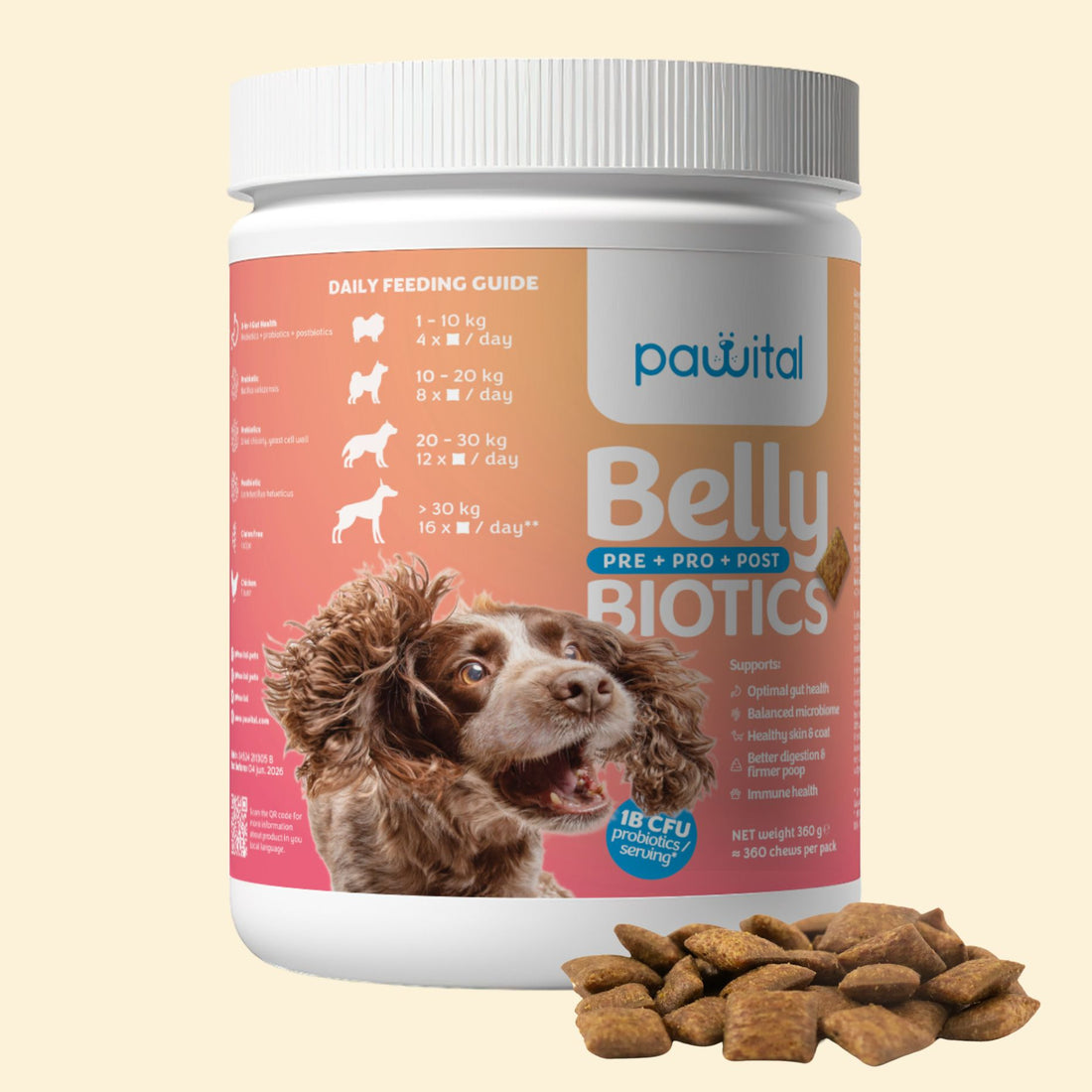 Belly Biotics (360 priboljškov)
- Regular price
-
€29,90 €79,90 - Regular price
-
€29,90 - Sale price
-
€29,90 €79,90
-
Belly Champ SLO
 Belly Champ SLO
- Regular price
-
€24,85 €104,90 - Regular price
-
€24,85 - Sale price
-
€24,85 €104,90
